
Beyond Wedding Photography: My Master's in Fine Art Photography

A little insight into the photographer behind Annie Rees Photography
Most people know me as a wedding photographer. I spend my weekends capturing beautiful celebrations, meeting wonderful people and documenting some of the happiest moments of their lives.
But there’s another side to my photography that rarely appears on my website.
In 2021, I returned to university to study full-time for a Master’s in Fine Art Photography at Gray’s School of Art in Aberdeen.
What an experience that turned out to be!
I expected to spend the year developing my photography skills, experimenting with different genres and learning a few new techniques.
Instead, I found myself questioning everything from consumerism and capitalism to social media, human behaviour, identity and the very purpose of art.
There were also some rather unusual photographic experiments along the way.
Looking back at the photographs of myself from that period, it’s clear that I’ve changed too, not least because I’ve since lost five stone!
Quite a lot has changed.
Who Are You? The Beginning of My MFA
My Masters project was titled Who Are You?
It seemed like a relatively simple question, but the more I explored it, the more complex it became.
The original concept grew from my own experiences and questions about identity.
Who are we? What shapes the people we become? How much of our personality is truly our own, and how much is influenced by the society in which we live?
At the time, we were emerging from the COVID-19 pandemic. Society had changed considerably, and technology and social media had become increasingly influential in our lives.
I became particularly interested in the contrast between our physical identities and the versions of ourselves we present online.
Social media allows us to construct and carefully curate an identity. We select the photographs, decide what to share and control how we would like others to see us.
But how closely does that curated identity reflect the person behind the screen?
As a photographer, I found this fascinating.
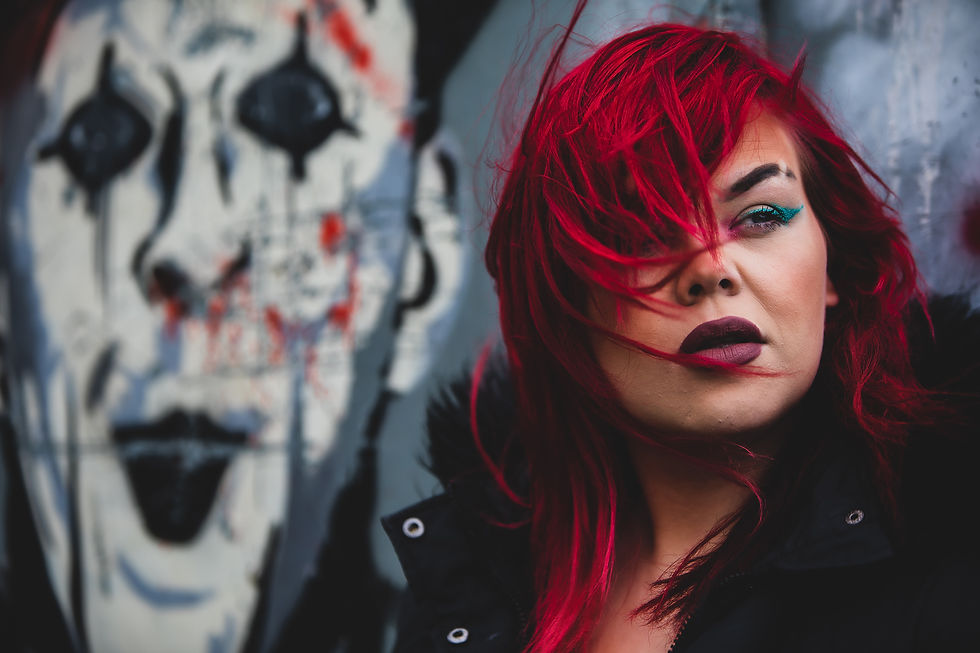
Through portrait photography, I began exploring how people presented themselves and the ways their identities had been shaped by personal experiences and their relationships with social media.
It became an intriguing exploration of identity, perception and the psychology behind a photograph.
Exploring Photography Beyond My Comfort Zone
One of the things I hoped to achieve during my Master’s was to move beyond the familiar.
As a professional photographer, it’s easy to become comfortable within a particular style or genre. You discover what works, develop your skills and continue refining your approach.
But every so often, it’s important to challenge yourself.
Throughout the course, I experimented with portraiture, conceptual photography, still life and documentary photography, as well as techniques I wouldn’t ordinarily use in my commercial work.
Some of the projects became rather surreal.
I spent time photographing vegetables and experimenting with lighting, composition and unusual arrangements. Something as ordinary as a pepper could take on an entirely different character depending on how it was photographed.
Other projects were considerably more provocative.
One particularly unusual experiment was Ratburger, a conceptual photography project exploring consumerism, marketing and our relationship with the products we consume.
I’ll admit that photographing rats in burger packaging was probably as far removed from wedding photography as I could possibly get!
But that was precisely the point.
I wanted to explore how photography can shape the way we perceive something. The same principles of lighting, styling and composition used to make a product look appealing could also be used to create something deeply unsettling.
Photography isn’t simply about making things look beautiful. It can challenge assumptions, raise questions and influence the way we see the world.
I found that absolutely fascinating.
Aberdeen in Photographs: Documenting a Changing City
As my studies progressed, I found myself increasingly drawn to documentary photography.
I became fascinated by the relationship between society, consumerism and the changes unfolding around us.
Having previously worked for Royal Mail, I began photographing neglected postboxes and exploring their significance as familiar objects within British communities.
What began as a relatively small project soon grew into something much larger.
I started photographing Aberdeen.
During the early months of 2022, I spent time walking through the city centre, documenting empty shops, abandoned buildings, street art and the changing face of the high street.
Aberdeen Market was being demolished. Familiar businesses had disappeared, while buildings that had once played an important role in the city were being repurposed or left vacant. I became particularly interested in how people responded to these changes.
One of my photographs captured a woman using her mobile phone to photograph the demolition of Aberdeen Market. I found something particularly meaningful in that moment.
There I was, documenting the disappearance of a familiar building, while someone else was doing exactly the same. In our own ways, we were both preserving a moment in the city’s history.
That is one of the things I find so powerful about photography.
We don’t always recognise the significance of an image at the moment we take it. Sometimes it is only years later, once buildings have disappeared, people have changed and the world has moved on, that a photograph reveals its true value.

Photography as a Historical Record
During my Master’s, I researched the work of documentary photographers including Tish Murtha and Martha Cooper.
I was particularly influenced by Murtha’s photographs of working-class communities and youth unemployment in North East England during the 1980s. Her images captured ordinary people living through extraordinary social and economic circumstances.
Similarly, Cooper documented the emerging street art and graffiti culture of New York, preserving fleeting moments that would later become significant records of cultural history.
Neither photographer needed to create or manufacture a story. They simply recognised that something important was happening and chose to document it.
My dissertation examined parallels between Britain in the 1980s and the social and economic changes unfolding during the early 2020s. I was interested in whether periods of uncertainty could inspire new artistic movements and how photography might preserve evidence of those changes.
My collection, Aberdeen in Photographs, became an important part of that investigation.
Images of bins, boarded-up shops, deteriorating buildings and unexpected pieces of street art may not sound especially exciting. Individually, however, they tell small stories. Together, they create a record of a city at a particular moment in its history.
That is what documentary photography does so beautifully.

What Did My Masters Teach Me?
A Master’s in Fine Art Photography is about far more than learning how to take photographs.
It’s about developing ideas, researching concepts, challenging your own perspectives and discovering how to communicate meaning through your work.
Throughout the course, I was encouraged to question every creative decision. Why had I taken a particular photograph? What was I trying to communicate? Did the image successfully convey my intentions?
Perhaps more importantly, what could I learn when something didn’t work?
I became increasingly interested in reflective practice and the idea that failure plays an essential role in creative development. Not every experiment results in a masterpiece. Some simply don’t work at all.
But understanding why an idea hasn’t succeeded can be every bit as valuable as creating something you’re proud of.
I also discovered how much I enjoyed the academic side of the arts. Researching ideas, exploring philosophical arguments and considering different perspectives became just as engaging as creating the photographs themselves.
The course gave me an opportunity to grow both creatively and intellectually, while learning to see photography from an entirely different perspective.
So, What Has Fine Art Got to Do With Wedding Photography?
Quite a lot, actually.
Although my Master’s explored subjects far removed from weddings, the fundamental principles of photography remain remarkably similar.
At its heart, photography is about observation. It’s about recognising a moment, understanding its significance and deciding how best to preserve it.
When I photograph a wedding, I’m not simply capturing a ceremony, a dress or a beautifully decorated venue. I’m documenting people—their relationships, personalities, emotions and interactions.
The nervous anticipation before the ceremony. The laughter between friends. The unexpected expressions and small gestures that might otherwise pass unnoticed. Each becomes part of a much bigger story.
Just as my photographs of Aberdeen will grow more interesting as the city changes, wedding photographs often become more meaningful with time.
People change. Families grow. Children become adults. Sometimes, the people in our photographs are no longer with us.
When that happens, seemingly ordinary moments become extraordinary.
I love creating beautiful portraits, and I take enormous pride in the finished photographs I deliver to my couples. But I also believe there is something deeply important about documenting people authentically.
Not every photograph needs to be perfectly posed. Often, the images that come to mean the most are those that simply capture life as it unfolds.
That is what draws me to documentary wedding photography.
Looking Back, and Looking Forward
It’s now several years since I completed my Master’s, and every so often I find myself revisiting the photographs and research from that time.
Some projects still make me smile. Others remind me just how much my photography has developed. And a few leave me wondering what on earth I was thinking!
The self-portraits are particularly interesting to look back on. Physically, I’ve changed considerably, having lost five stone since then, but I think it’s fair to say I’ve changed in many other ways too.
What I value most about the experience is the freedom it gave me to explore photography without the expectations of commercial work. I wasn’t creating images for clients or following a wedding brief. I was making photographs simply because something interested me—because I wanted to explore an idea, challenge a perception or discover what might happen if I tried something different.
I believe that kind of freedom is important for any creative professional.
My wedding photography business continues to evolve, and over the years I’ve developed a much more consistent and recognisable style. But behind that style, I’m still a curious photographer, someone who enjoys observing people, questioning ideas and finding the extraordinary in the ordinary.
Perhaps that curiosity is the most valuable thing I took away from my Master’s.
Photography isn't simply about what we see. It's about how we see it, and why we choose to remember it.
Annie x


Comments